
What Is a Spurtle? The Complete Guide
What is a Spurtle?
A spurtle is a slim, paddle-shaped stirring stick that does the work of a spoon, a spatula, and a scraper. It reaches the corners of a pot, slides under a fried egg, folds batter, and scrapes a pan clean without scratching it. Scottish cooks have used spurtles for centuries. Ours descends from the flat kind, not the porridge stick.
Lucinda Scala Quinn built the modern version. After more than a decade as Executive Food Director at Martha Stewart Living, she redesigned the spurtle for the way people actually cook now: curved to fit any pan, long enough for a stockpot, and made in materials that hold up to daily use. Mad Hungry has since sold more than five million spurtles through our shop, QVC, and Lowe’s.
We make them in two materials. Choose yours based on what you’re cooking.
The classic wooden spurtles
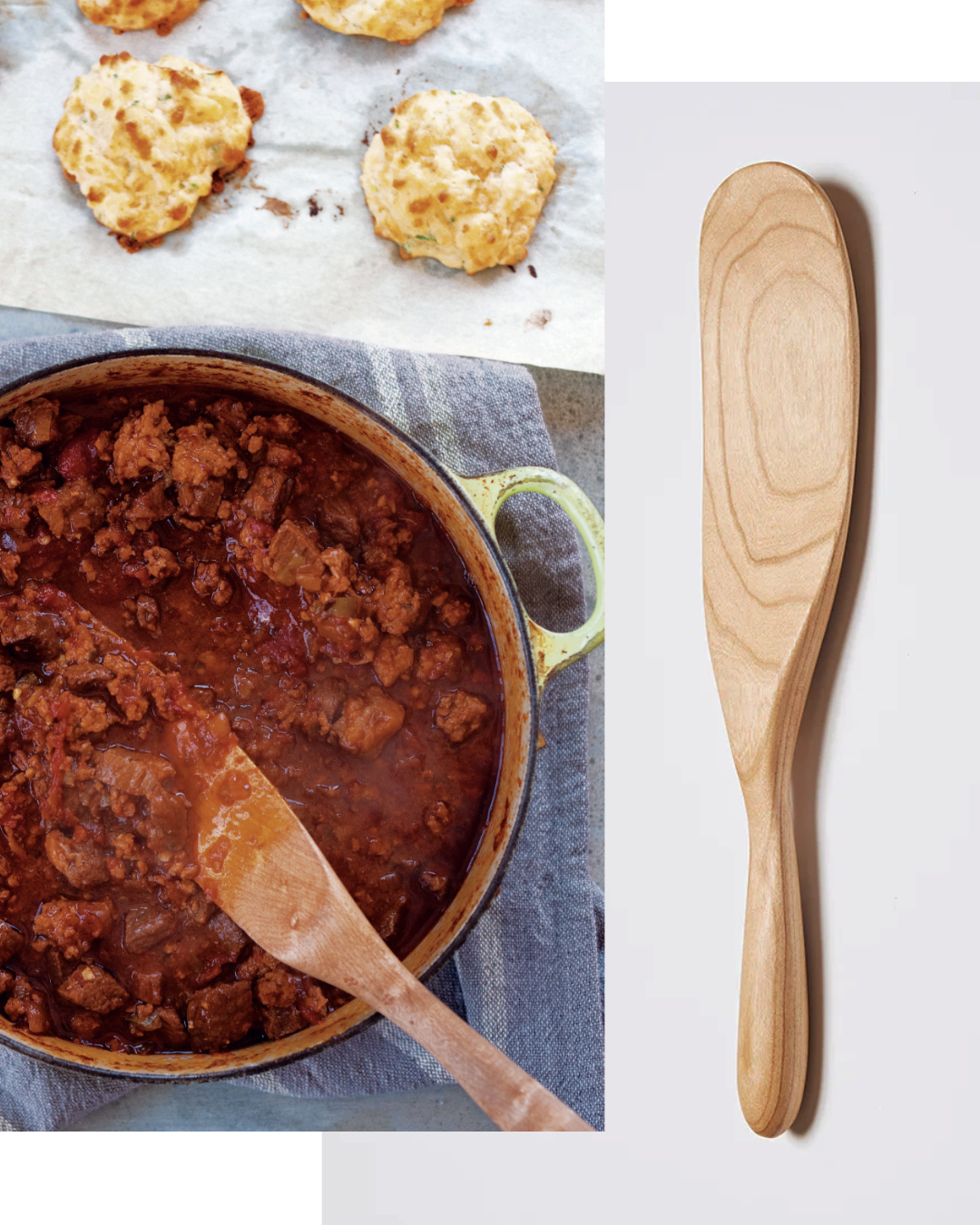
This is the spurtle in its original form, cut from double-baked, hand-finished acacia and, in our premium line, American cherry. Wood is rigid, which is what you want for heavy stirring: a thick stew, a pot of polenta, a risotto that needs coaxing. It never gets hot in your hand, it won’t mark enameled cast iron, and it looks like it belongs when left out on the counter.
Care is simple: hand wash, dry it with a dishtowel, and rub in a little mineral oil when it starts to look thirsty. Keep it out of the dishwasher, use it with love, and it will repay your affection with delicious food for a long time.
Scratch-free silicone spurtles
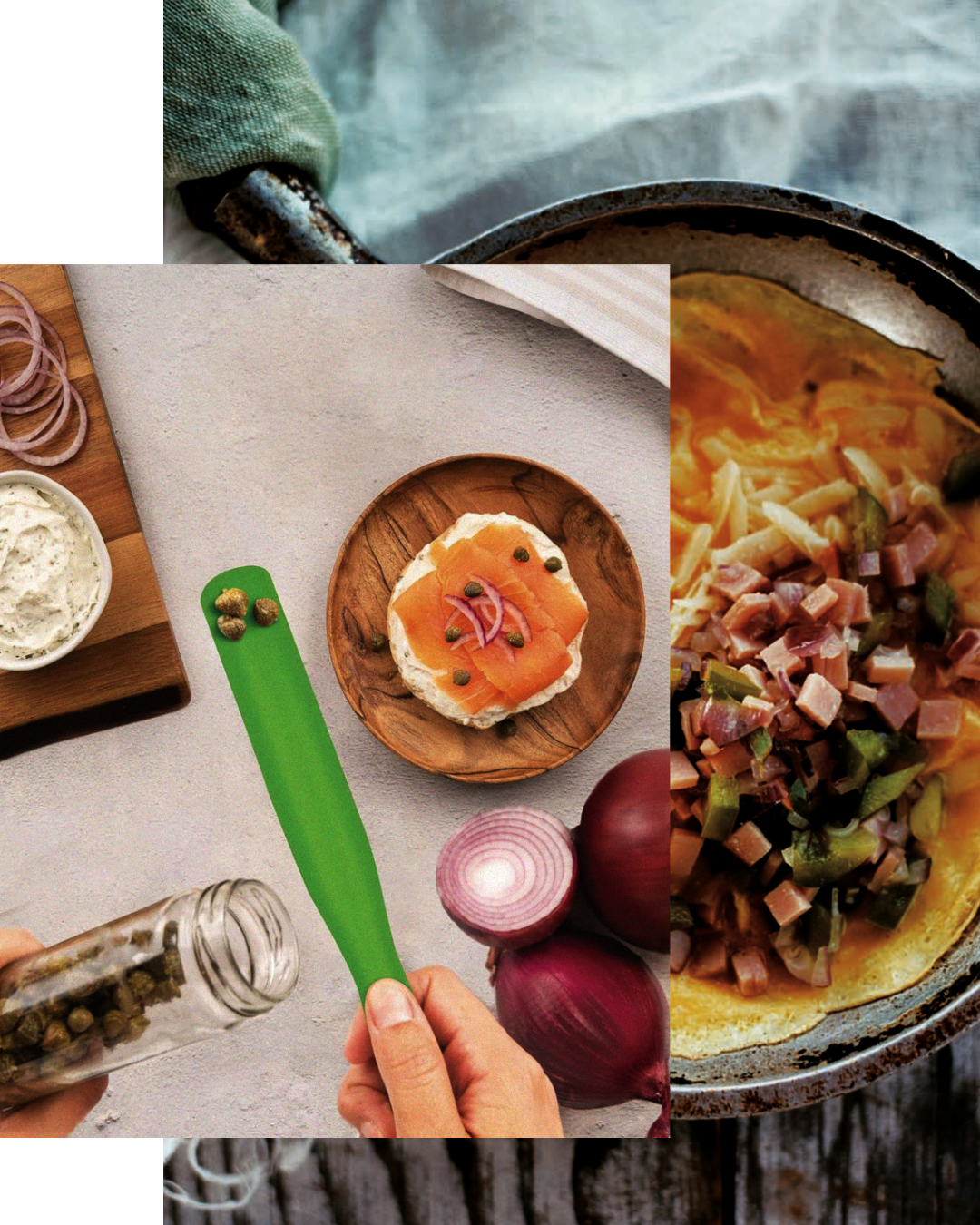
Food-grade silicone over a solid nylon core gives this spurtle just enough flex to scrape a bowl clean and enough spine to fold, flip, and serve. It’s heat-resistant to 480°F, safe on nonstick, ceramic, and stainless, and it goes in the dishwasher.
Use it to stir risotto without crushing the grains, deglaze a sauté pan, spread frosting, or lift a fish fillet without breaking it. The slim profile gets into the curve of a pot where a flat spatula can’t.
What makes it different from a spatula? A spatula is flat and rigid. A spurtle is shaped to get into corners, curve around edges, and handle both stirring and serving. It’s the tool you reach for first and put down last.
By Lucinda Scala Quinn
Every single day I pull a spurtle out of the crock next to my stove. It is the first tool I reach for and usually the last one I put down. People see it in my kitchen and ask, “What’s that elongated wooden spoon thingy?” I tell them: it’s a spurtle, Myrtle. Nobody forgets the name after that.
So here is everything I know about spurtles, after more than ten years of making them, selling them on QVC, and cooking with them every day of my life.
What a spurtle actually is
A spurtle is a long, flat kitchen tool that combines the attributes of a spatula, a spoon, a server, and a scooper. It stirs. It scrapes. It spreads. It scoops. It folds. It lifts. It does all of it without scratching your pan.
The name is Scottish, and Scotland has two kinds. One is a rod, a tapered wooden stick made for stirring porridge. The other is flat, a long-handled blade for turning oatcakes on a hot griddle. The Mad Hungry spurtle descends from the flat one, and we made it do a great deal more than turn oatcakes.
That’s the short version. The longer version is why I designed ours the way I did.
Where our spurtle comes from
The first spurtle I ever saw was not in Scotland. It was in Seattle, at Pike Place Market, carved by a woodworker named Jim Wilson. His spurtles were hand-carved heirloom tools in hickory, maple, and cherry. They were curved, narrower than ours, and not the size you’d expect. That size is what got me. It was long enough to reach the bottom of a deep pot and flat enough to work the sides of a pan. I bought one, cooked with it, and could not stop thinking about what a tool like that could become. I give credit where credit is due: it’s from Jim Wilson that I first learned what a spurtle was, and from his that ours evolved.
Ours is squared off at the bottom, flat and beveled on three working edges, and shaped so it reaches into the curve of a low pan and up the tall sides of a stockpot. That’s the design. It has nothing to do with the porridge stick. Knives come in different shapes for different jobs. So do spurtles.
Years later, after we’d had real success with it, I was invited to the international porridge-stirring championship, which that year was held at Bob’s Red Mill in Oregon. That’s where I finally saw the rod-style Scottish spurtle in action. Beautiful, and beside the point. When oatmeal was made from whole oats with the husk still on, you needed a mallet-like stick to mash and stir those grains into porridge. Today’s oats arrive hulled, split, and often pre-cooked. We are not mashing. We are stirring, spreading, scooping, and scraping. The flat spurtle is the one for the modern kitchen.
Why it works: three edges and a flat bottom
Here is what makes a spurtle wonderful, and I say this as someone who has used practically every stirring tool ever sold.
In a low pan, the spurtle gets into the curve where the side meets the bottom. Turn it upright in a tall pot and the long flat edge squeegees everything off the wall of the pan. The squared-off bottom reaches the corner that a round spoon never touches. Three edges, all working.
Now think about a wooden spoon. You’ve got this big long tool and you’re only using the little round bowl at the end. When you want the batter off it, you use your finger. With a spurtle you scrape it clean on the side of the pan and keep going.
A spatula does one thing. It lifts stuff up. A spurtle lifts, and then it stirs, scrapes, spreads, and serves.
If I had to set up a kitchen in an apartment with five things, I’d take a knife, a spurtle, a cutting board, and a pan. That covers nearly every job. The fifth thing is a bowl.
Wood or silicone
There was nothing wrong with the wooden spurtle. The wood is what made it special. But customers kept asking for silicone, and I resisted until my own KitchenAid changed my mind.
I was making a batter with the paddle attachment, and every time I needed to get the batter up from the bottom of the bowl I had to stop the motor and lift the paddle. Stop, lift, scrape, lower, and start over. And I thought: if I had a spurtle made of silicone, I could slide it under that paddle while it runs. That just might be a game changer. In 2015 we made a silicone spurtle in the exact shape of the wooden one. It turned out to be everything the wood was, plus a squeegee effect on all three sides. It gets under the paddle of a stand mixer or a food processor without stopping the machine. It scrapes a bowl clean.
So which do you want? Both, if I’m honest, and that’s what most of our customers end up with. But here’s how I actually use them.
- Wood is what I reach for at the stove. Sauteing in a hot skillet, stirring a pot of sauce, browning meat. Ours is double-baked, hand-finished acacia, or cherry for the American-made one, and every piece looks a little different from “nature’s thumbprint” on the wood. It ages like cast iron. It gets a patina. It gets better.
- Silicone is what I reach for when I’m baking. Folding whipped cream into chocolate, smoothing a batter, scraping a mixing bowl, spreading frosting. Ours is food-grade silicone over a solid nylon core, heat-safe to 480°F, and it goes in the dishwasher.
You could do either job with either tool. For the precise baking jobs, silicone is a little better. For a screaming-hot pan, I like the feel of wood in my hand.
Both are safe on nonstick and on enameled cast iron. Neither scratches or scrapes a pan surface.
Twelve things I do with a spurtle every week
People ask what a spurtle is for. Here is what mine did this week, dish by dish.
- Scrambled eggs. It gets the eggs out from around the curve at the bottom of the pan, so nothing overcooks against the metal.
- Chocolate mousse. Folding whipped cream into melted chocolate. The flat edge cuts down through the middle and sweeps up the side without knocking the air out.
- Mirepoix. Onion, carrot, and celery sauteing in olive oil, the start of half the dishes I make.
- Tomato sauce. Stirring the tomatoes into the onions, then stirring the pot as it simmers. “Stir the sauce” is the phrase every Italian American kid grew up hearing. This is the tool for it.
- Granola. Spreading it out on the sheet pan before baking, then turning it over halfway through.
- Meatballs. Turning them as they brown in the pan. The flat edge slides under without tearing.
- Chili. Breaking up ground meat as it fries and stirring it until it’s evenly browned.
- Tuna salad. Mashing the tuna, mixing in the mayonnaise, spreading it on the bread. One tool, start to finish.
- Mayonnaise from the jar. The mini or the skinny spurtle gets down into the jar and comes out with every last bit.
- Salad. Tossing the dressing through.
- Avocados. Scooping the flesh out of the skin in one pass.
- Rice krispie treats. Pressing them down into the pan. The jumbo spurtle covers a lot of ground here.
Add to that oatmeal, pasta, risotto, and any task in a pan that requires you to stir, which is most of them.
Spurtle vs. spatula vs. wooden spoon
- Spurtle vs. spatula. A spatula is a lifter. Wide, flat, built to get under a pancake and flip it. It won’t stir a pot well and it can’t reach the corners. A spurtle lifts nearly as well and does everything else too. I still reach for a true spatula for a big, thin pancake or a burger, which is exactly why we make a spatula-shaped spurtle.
- Spurtle vs. wooden spoon. A wooden spoon has a bowl, and the bowl is the problem. It holds food instead of moving it, only the bottom tip does any work, and you clean it with your finger. A spurtle’s flat edge moves food, scrapes the pan, and wipes clean on the rim.
Every spurtle we make, and what each one is for
We make spurtles in all sizes, which means one for every pan, every hand, and every job. Small job in a small pan, use a small spurtle. A big pot of ziti, use the jumbo. A little spreading job, use the skinny one. These are the ones we sell, wood first.
The wood spurtles
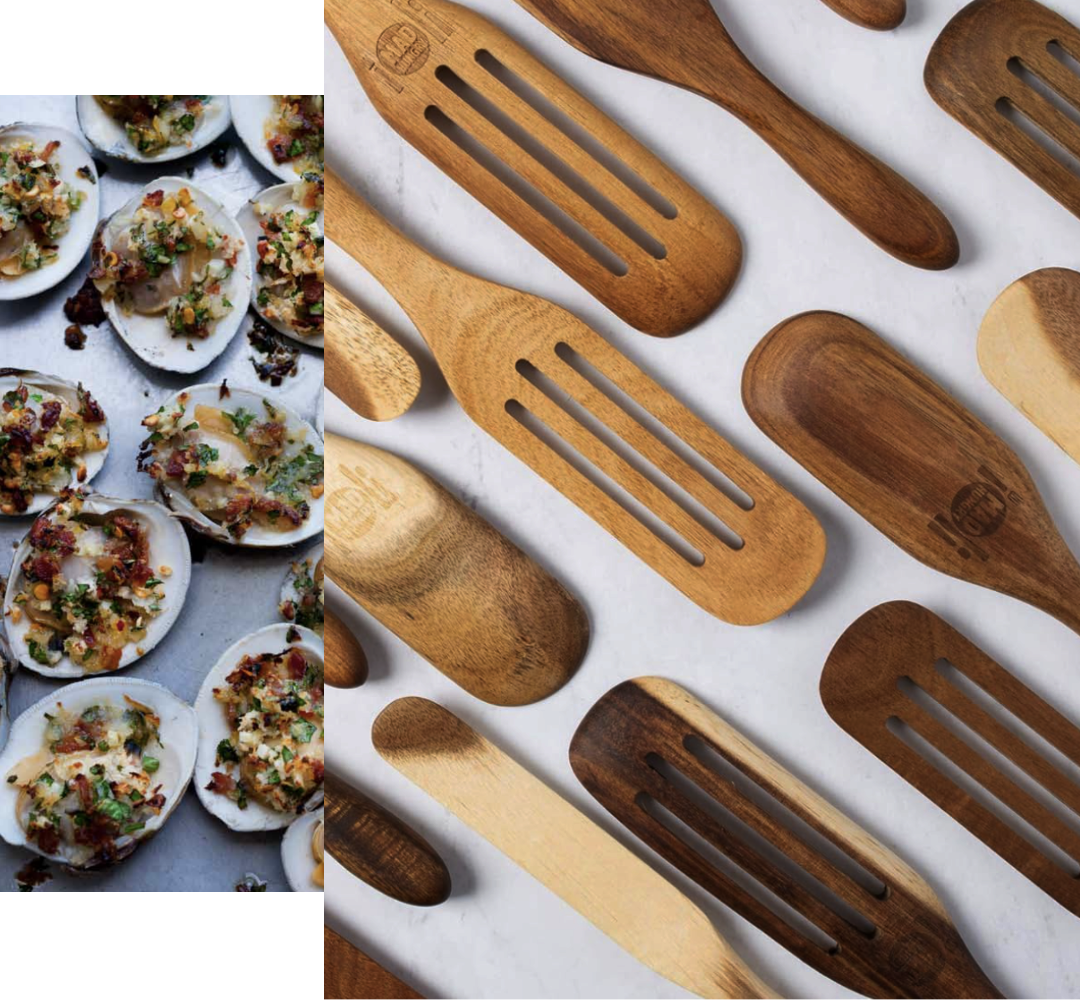
- Acacia Original Spurtle, 12 3/4 inches. The one that started it all and the most multi-use tool in the line. Double-baked, hand-finished acacia, each piece one of a kind. Hand wash only.
- Cherry Wood Spurtle. The Original shape, handmade in Ascutney, Vermont, from cherry sustainably harvested in the Green and White Mountains. This is the heirloom. Each woodgrain and shape is slightly different.
- Acacia Mini Spurtle, 8 1/2 inches. The small jobs, plus it gets into jars for peanut butter, mayonnaise, and butter.
- Acacia Slotted Spurtle. Everything the solid one does, plus it whisks eggs, sifts flour with the baking soda and spices, and mashes bananas for banana bread or avocados for guacamole.
- Acacia Skinny Spurtle, 8 1/2 inches by 1 inch. An extension of your fingers. It reaches into a small-mouth jar for capers or horseradish or jam, spreads butter, ices a cupcake, and puts cream cheese on a bagel.
- Acacia Offset Spurtle. The Original with an angled head, so you can work more horizontally in a saute pan and get right into the corners.
- Acacia Scooper Spurtle. A spurtle with a two-tablespoon scoop in the head. Pick up a splash of oil or vinegar, or measure as you stir.
- Acacia Spreader Spurtle, about 7 inches. Based on a classic Swedish butter knife: a beveled, knife-like tool for butter, mayonnaise, and jam. A lovely first tool to put in a young cook’s hand.
- Acacia Chopper Spurtle. I designed it for chopping meat in the pan. It turned out to be the best way to scoop chopped onions or carrots off the counter and into the skillet. Beveled edge, so it works as a spatula too.
- Bamboo Original Spurtle and Bamboo Mini Spurtle. Bamboo was one of the first spurtles we ever brought to QVC. The line has grown since, but we still love it: same shapes as the acacia, lighter in the hand.
Every wood spurtle gets washed by hand with soap and hot water. And that’s facts. No wooden tool goes in the dishwasher.
The silicone spurtles
- Silicone Original Spurtle, 12 inches. The wooden Original in silicone. Does every stovetop job, and its beveled edge squeegees batter out of a bowl and slides under a mixer paddle without stopping the motor.
- Silicone Mini Spurtle. The Original, sized for smaller jobs.
- Silicone Slotted Spurtle. Whisks eggs, even separates them, sifts dry ingredients, mashes bananas and avocados, and still squeegees a bowl clean.
- Silicone Slotted Spatula. A wide spatula with slots in the head. Lift a burger or a piece of fish out of the pan and the liquid strains through.
- Silicone Offset Spurtle. The angled head and the curve of the edge let you dig a thick batter out of a bowl and smooth or spread it.
- Silicone Skinny Spurtle. Works like your finger. Butter on toast, icing on a cake, cream cheese on a bagel, peanut butter on anything.
- Silicone Spatula Spurtle. We call it the Spurtula. A wide, long surface for anything big and thin you need to flip: pancakes, burgers, a steak.
- Silicone Jumbo Spurtle. Wider at the base and more curved. For the big jobs: a bowl of rice krispy treat mixture, a big batch of baked ziti getting mixed with the cheese and sauce, anything where you need surface area.
- Silicone Chopper Spurtle. Part bench scraper, part spatula. Scoop ingredients off the counter, lift bread dough, cut up ground meat in the pan.
- Silicone Scooper Spurtle. The two-tablespoon scoop in silicone. Add oil to the pan, measure an ingredient, keep stirring.
- Silicone Spreader Spurtle. Cream cheese on bagels, jelly on toast, frosting on cupcakes, and it will cut soft fruit.
Silicone washes by hand easily and also stands up to the dishwasher, which is why some people prefer it.
Recipes where the spurtle does the work
Any recipe in our cookbooks was cooked with a spurtle. A few where it matters most:
- Tomato Sauce. Crush the tomatoes right in the pot, then stir as it simmers. The flat edge keeps the bottom from catching.
- Sunday Sauce. An all-day pot with meatballs and ribs. The long handle keeps your hand out of the steam and the flat bottom sweeps the base of the pot every pass.
- Scrambled Eggs. Low and slow, with constant gentle movement around the curve of the pan.
- Risotto. The narrow edge stirs without crushing the rice and scrapes the bottom so nothing sticks.
- Browse all Mad Hungry recipes
How to care for a spurtle
- Wood. Wash by hand with soap and hot water, dry it, and put it back in the crock. If it starts to look dry, rub in a little food-grade mineral oil or beeswax. Really, the olive oil it picks up from daily cooking does most of the job. It will darken and take on a patina, the same way cast iron does. That’s a good thing.
- Silicone. Hand wash or dishwasher, either one. It can rest in a hot pan and it’s heat-safe to 480°F.
- Both. Safe on nonstick, ceramic, enameled cast iron, and stainless. Nothing about a spurtle will scratch a pan.
Frequently asked questions
What is a spurtle used for? Stirring, scraping, spreading, scooping, folding, lifting, mashing, and serving. It does the work of a spoon, a spatula, and a bowl scraper in one long, flat tool.
Why is it called a spurtle? The word is Scots, first written down in the 1500s. Where it comes from is debated. In Scots, “to spurtle” means to stir something round, and I’ve always thought the name sounds like the flicking, darting motion of the tool. Some dictionaries trace it back through Latin spatula and Greek spathe, a flat blade, which would make spurtle a distant cousin of spade and spoon. Merriam-Webster just says “origin unknown.” Either way, it rhymes with Myrtle.
What’s the difference between a spurtle and a spatula? A spatula lifts. A spurtle lifts, stirs, scrapes, spreads, and serves. A spatula is a specialist. A spurtle is the tool you grab without thinking.
What’s the difference between a spurtle and a wooden spoon? A spoon holds food in its bowl and only works at the tip. A spurtle’s flat edges move food, scrape the pan, and wipe clean on the rim. No finger required.
Is the Mad Hungry spurtle the same as a Scottish spurtle? No. The Scottish porridge spurtle is a tapered rod for stirring whole-grain oats. Ours descends from the older flat Scottish spurtle used for turning oatcakes, and I redesigned it to reach the corners and sides of modern pots and pans.
Wooden spurtle or silicone spurtle? Wood for the hot pan at the stove. Silicone for baking, folding, and scraping bowls. Most people end up with both.
Is a spurtle safe on nonstick pans? Yes. Wood and silicone both. Neither one scratches nonstick, ceramic, or enameled cast iron.
Can a silicone spurtle go in a hot pan? Yes. Mad Hungry silicone spurtles are heat-safe to 480°F.
Can a spurtle go in the dishwasher? Silicone, yes. Wood, never. Wash wood by hand with soap and hot water.
Do I need to oil a wooden spurtle? Now and then, with food-grade mineral oil, if it looks dry. Daily cooking with olive oil takes care of most of it.
What size spurtle should I buy first? The Original, in wood or silicone. Then add a mini for jars and a slotted one for eggs and mashing. If you cook for a crowd, the jumbo.
Who invented the modern spurtle? I did, at Mad Hungry, starting from a hand-carved spurtle I bought from Jim Wilson at Pike Place Market in Seattle. I designed the flat, three-edged shape we sell today and, in 2015, the first silicone spurtle.
Lucinda Scala Quinn is the founder of Mad Hungry, author of eight cookbooks including the bestselling Mad Hungry trilogy and Mother Sauce, and the former Executive Food Director at Martha Stewart Living. She has cooked professionally since she was fifteen and has appeared on QVC with her spurtles since 2013.